

We now note that that we do not waive our attribution requirements for Spritely Goblins, which are present in Apache v2 (and for that matter, CC BY, CC BY-SA, and most FOSS licenses) https://codeberg.org/spritely/goblins/pulls/998/files
So if you train on our codebase, you have to retain attribution, which we consider the most important requirement to motivate development of technology in the commons.
If, somehow, you are using a statistical soup which has no way to preserve attribution, well, we don't permit or approve of dropping such a requirement, and actually, the licenses we use never have.
Thanks also @davidrevoy for inspiring adding such a notice https://framapiaf.org/@davidrevoy/117440226629383529
RT: https://framapiaf.org/users/davidrevoy/statuses/117440226629383529
Btw I thought I heard @bkuhn saying (but with their post-hoc permission, naming them now to clarify) that nobody cares about attribution requirements (and particularly not enforcing them). But to me, attribution is what I care about MORE than any other licensing requirements, more than copyleft "share-alike" style provisions, etc.
If you feel similarly, it would be good to hear on this thread. Perhaps even copying a similar notice into your project is a good idea.

@cwebber I agree. I extremely dislike copyright (and would like it to be abolished even if that makes copyleft licenses (even more) useless), but I think that attribution and often also proper citation/references is extremely important.

@cwebber What I've found, at least in writing, is that people want to be recognized for what they've made, and properly credited.

@cwebber attribution in licenses is how UC Berkeley brought down AT&T and the UNIX System Labs.




@cwebber What if the attribution is then done to every piece of training data? That's not impossible if the training data is known, but will it be acceptable?

@cwebber attribution is the single most valuable thing a person or a project could get imho. But i guess this is due to the fact the most of the tech persons in the past were either academics or people with high hacker ethics. I miss the times were tech especially in opensource was about getting the badge to be a smartass or a project everyone looks up to. Nowadays even opensource projects just try to be funded or bought by a third party

@cwebber I've always considered it to be important to respect even when it is optional. Tangerine had an attribution page that reproduced the license/copyright notices for the entire dependency graph. I had all the dependencies vendored, so the page was generated automatically from the sources. Mollytime will have a similar feature (eventually) once we're done rebuilding the UI and I figure out a way to do it without vendoring everything.

@cwebber I share a similar stance. While I strongly prefer share-alike provisions, attribution is by far the most important. When I chose my preferred post-floss license1, I chose one2 that has no share-alike clause, but does have an attribution one.
Because while I like the idea of FLOSS, I absolutely do not like that I can't restrict who can use my software. ↩︎
@cwebber i think over the decades my hopes for my FOSS work burned down from a big important career making big important things, to hoping anyone at all finds my stuff to be useful for something, to i guess i can entertain a few dozen people for a few minutes every now and then, to ok i get it pausing your music to listen to worse music is too much to ask, to, look, i drew some pictures do you like pictures
@cwebber and the idea that the outcome of this is my work being slurped up into a training set for my contributions to be misattributed to the theft machine, and nobody knowing i exist is not ok

@cwebber Too many folks in and around FOSS think "nobody has taken enforcement action over this, therefore nobody actually cares about it." It's wrong and it signals that the person is thinking about FOSS in terms of what they can extract rather than a collaboration among peers.
@cwebber but ultimately i'm not interested in taking anyone to court. i don't have the money to burn for that, and the impact on my health would probably be unlikely to have been worth it to me. so all i get out of a license is a statement of intent. people generally are good about respecting the intent of the license, so that's worked out well so far (even if it's been mostly not applicable anyway). but these ai companies don't give a shit, and i'm at a loss of what to do about it

@cwebber Attribution is pretty much the only thing I ever cared about (and I still care about it, very much). I also do not believe prominent people when they say they "don't care" about attribution. Like, really? So if someone had never credited your work your entire career and/or claimed it for themselves, you think you'd be in the same position as you are now? Or is attribution only important when you're on your way up the ladder?
I have a *lot* of feelings on attribution, in fact.

@cwebber i'm an artist/academic/educator and i consider making foss to be a part of my practice. any kind of attribution helps me to make the case that my work has "impact" which in turn helps me to keep my job. a lot of foss projects that are related to academia in some way will request that papers resulting from research that makes use of the project include an actual bibliographical citation—i assume for similar reasons. tbh i think this prominent foss person is full of it

@cwebber attribution seems like the most basic social reciprocity available and, as you mentioned, probably the most important. "where did you get *awesome idea from*? "oh *awesom idea* came from *this person*. aren't they neat?"

@cwebber absolutely, attribution is the most important part of the whole thing. Citing your sources seems to me to be one of the most basic parts of human decency.


@cwebber i don’t code in any meaningful sense (thankfully) but unless the point is some sort of ephemeral anonymity, attribution is generally the thing i care most about with the art i do put out into the world.
@cwebber and I feel some people really tell on themselves with their attitudes towards consent and truth


I tend to release things under ISC/MIT/BSD (2-clause) type licenses because attribution is nice—theoretically required by the licenses—and more significant to me than any share-alike terms. But in the end, I'm more interested in solving problems and sharing those solutions. And similar to @datarama's insightful reply, "as long as 1. you don't claim that you made my work, 2. you don't claim that I made your work."

@cwebber It is an interesting thought & problem.
The issue with any licensing is firstly enforceability & legality. Just because you put something in a license file doesn't mean you can enforce (as in courts would rule in your favour).
Big OSS licenses have the advantage of being legally verified and supported by precedent.
@ilia These clauses already exist in prominent, and previously enforced, licenses. We didn't add anything, just called attention to the clauses.
(And yes, I have done a substantial amount of work on FOSS licensing issues.)

@cwebber attribution is literally the only possible reward when you give your software away for free. It's all there is, so it's all that matters.

@cwebber I hate copyright but want some credit for stuff I do, cuz that's the coolest thing someone can give me for the work I do for fun. So, the thing I care about the most is attribution, and that is why I license my stuff copyfree. If I didn't care, I would license it public domain, but attribution feels kinda like praise; I made something useful enough for someone to use, and I know that because they are attributing me

I feel somewhat different about the whole issue, and I want to underline something:
Permissive licenses are about developer freedom, but copyleft licenses are about user freedom. I care about user freedom more than developer freedom.
Another angle is, if I create a tool/library and I share it for free, it's GPLv3. User freedom is non-negotiable plus, I don't want my free work to be sold to anyone. It's created to be free as in beer and as in speech.
I don't allow otherwise.
@bayindirh yes, I am one of the people who popularized "user freedom" as a term, partly in my talks about copyleft.

@cwebber +1 to all of the above. Attribution is just so cheap to do, it's a red flag when it's too much effort for somebody.
@cwebber Kudos to you. I don't remember where I read it first, but I write it everywhere the discussion permits.
From my understanding many FOSS developers don't understand how GPL/copyleft works, and as a result they are afraid of it.
Many developers don't care as well, and love MIT because it's "carefree".
Every license has its place, but there shall be more GPL software IMHO.

I have a project repository that started out as a fork and eventually morphed into a project that was reworked into something beyond the original scope to become something new.
I still have attributions to the original author and posted the links to the previously forked repository. It was the spark, after all, and it is just as relevant in the timeline as it was when it was the origin.
Given that the project is a list (in this case, a blocklist), it can't really be copyrighted.

@futzle Well, open source is in many ways a *reaction* to software becoming subject to copyright in 1980, whereas previously all software was in the public domain

@cwebber Attribution's probably the most important part: it's how we can trace the history of programs because the Ladies of the Chips know programmers are pretty bad about recording our own history.

@cwebber I care heavily about attribution because that's the way you trace back to who's responsible for a piece of code. You can't enforce any other requirements if you can't identify who the code came from, and you end up taking the heat for any problems.
And of course there's the good-manners part, which I prefer to be the important part because the above only matters if there's problems and I prefer there not to be problems.

I'd say I mostly care about attribution for my own projects in the same manner that I care about copyleft. I want software to be an unmistakably social endeavour, and I think attribution is a piece of that goal in addition to copyleft. I weigh copyleft a little higher because it makes up more of the pieces of my ideals by number, but I think attribution is very important as well. It's important to see code in its social context.

@cwebber I definitely think sharing credit for where I got an idea is super important! I do appreciate when I receive it, but definitely think I care more about making sure I give the proper credit.

@cwebber I, for one, mainly care about proper attribution. Aside from MIT/BSD and LGPL for software, most all the #3DPrinting designs i publish go up under CC BY 4.0.
Attribution is key.

@cwebber My history is in both academic computer science and physics, and in both fields attribution is *paramount*. Reviewers will, correctly, hold papers back from publication if work isn't cited properly, especially if it's the reviewer's own work :)
Of course in practice some things things slip by, work is stolen between peers and between professors and students all the time, but the intention is understood and important.
This inability to cite is perhaps the first thing that bothered me about LLMs. Code isn't cited, books and articles aren't cited, websites and blogs aren't cited (in addition to stealing meaningful traffic from them while paradoxically hammering them with scraping requests). It all goes to these companies' fundamental business model, which of course boils down to capitalism's standard procedure - steal the commons, then sell it back to us.

@cwebber attribution is vital for many of the reasons people pointed out already. But I can honestly say that every email with "hey, I have a problem with your stuff" is 100x better than 100 stars on a repo or whatever.
It simply wouldn't happen if nobody knew I wrote the code.
If nothing else, it underlines for me how this whole thing really is about people.

@cwebber I’ve always been surprised when I hear people say that given how many people clearly value it!

@cwebber having unwittingly become an expert in a certain cursed project, I say: attribution is SUPER IMPORTANT.
The cursed project when it was announced tried to hide they were based on ATproto, then launched and quietly went closed-source à la Truth Social.
And whenever they use other people’s tools built on ATproto, they are TERRIBLE at crediting them. Ouuuuuuf!

@cwebber I care about attribution. More so than in the past. Now that the fruits of our commons labour are being sucked into the genAI blender, sold back to the commons without consent nor attribution I try to be precise in giving proper attribution. I wish @creativecommons had stood up in enforcing attribution. Sadly they did not. Nor did other organisations afaik.
Makes me wonder what will be left of copyright. Will it solely be a right for the rich & powerful? Maybe it already was? 🤔

(1/2) @cwebber
I don't (nor should anyone serious about FOSS policy) say “nobody cares about attribution requirements”.
I can only speak for my own position, but my position (based on 30 years of community observation) is that (a) attribution is not particularly important to most *who choose* **non**-copyleft, & (b) attribution *alone* never had a particularly good enforcement hook.…
(2/2)…
I further am quite confident that we can rework #copyleft licenses to address most of the worst problems that #LLMGenAI represents for the future of #SoftwareFreedom.
I've been working on itsince ≈2026-05. It's slow going, but I'm confident that #CopyleftNext will present a good solution.
Meanwhile, I recently asked for @cwebber's help toward this, but didn't receive a response. If you have time, pls respond to this:
https://fedi.copyleft.org/@bkuhn/117425328332275949
#LLM #AI #LLMGenAI #OpenSource #FreeSoftware
RT: https://fedi.copyleft.org/users/bkuhn/statuses/117425328332275949



Maybe ive been reading too much into some words; or maybe Ive misunderstood.
BUT some of your conversations and comments on LLMs to me and others have had a distinct "attribution is going to be fucked in a post-LLM world, the best we can hope for is to preserve copyleft" vibe to it.
I would be hard pressed to find an example in our own comment history; as my toots self destruct after a few months. BUT it's definitely come up.
Anyway; am I wrong in that sentiment? Do you think there is a way forward with some of these LLM concerns preserving attribution?
If a statement I made seemed like I said that, I either misspoke or it was misquoted. (Also, I wouldn't have 🤬'd making a point like this in any event.)
My position is instead that enforcement of attribution requirements **by themselves** (without other copyleft provisions to provide scaffolding) has always been extremely difficult to nearly impossible in real world contexts. #LLMGenAI may make the problem more acute, but the problem has always been there.
Cc: @cwebber

@cwebber that's very interesting!
I'm not sure your licenses apply to training LLMs; it's not clear to me that copyright governs the training process.
I know you think differently; that a license attaches like a spell to the bits and bytes, no matter how small the excerpt or how varied the rearrangement.
The mechanism is not the issue. I think the expression of author intent is really important!
For Web resources, we have the AI preferences from IETF:
https://datatracker.ietf.org/doc/html/draft-ietf-aipref-attach-05
But, of course, Free Software doesn't just come from one website. It's made to be spread around. It would be good to have some sort of AI prefs expressed in the package itself, no matter where it is.

@bkuhn @trashheap I appreciate the clarification on your position here.
I still do hold the positions that attribution are the glue that hold the commons together, and it's important that we fight to preserve it, and not give the impression that it is being voluntarily waived in the face of LLMs.
I like the idea behind CC Signals but it needs to ship a prototype soon.

@cwebber @bkuhn @trashheap@tech.lgbt If bkuhn's right that permissive licenses make attribution hard to enforce, then the best way to accomplish that would be to use copyleft.
Anyway, if you keep Apache v2, it would certainly make sense to include a NOTICE file, since currently an Object derived from goblins does not need to attribute you at all. And as Apache v2 defines "Object", that seems to include AI models.

@cwebber @bkuhn @trashheap IMO the real challenge to FOSS enforcement against LLM producers is the same one everyone else has: if the training is fair use because the resulting model is transformative, the producer doesn’t need a license (and doesn’t have to respect the terms of any existing license). It’s still early early days in terms of court decisions, but this looks like the direction we’re headed in the US (though the outcome will likely vary depending on how much memorization a model can be shown to do).
@copiesofcopies @bkuhn @trashheap My main concern is that the resulting legislative environment is as equitable for FOSS as it is for the proprietary world, whatever the outcome is. In many ways this is why I'm happy to see the vibe-laundered versions of Adobe's suite etc, I think that will push the issue.
@cwebber @bkuhn @trashheap unfortunately, we’re falling behind quickly, just in terms of the regulatory impact on who can afford to build competitive models. The CLAIM Act (just introduced) is basically designed to compel anyone who trains a model to either: (1) make it impossible for that model to accidentally cause harm, or (2) buy expensive insurance to cover the damage from inevitable harm.
@cwebber @bkuhn If I compile goblins and give the object file to someone, without attributing you -- as Apache v2 seems to allow sans NOTICE* -- and that person decompiles it, we've generated source code that is derived from goblins but does not attribute you. Seemingly legally.
Wouldn't the same apply to generating an LLM and using it no matter what you might ask in your README?
* ignoring moral rights

@cwebber "i just don't want someone to take my name off my code" is absolutely something i've said to people before.

@cwebber right; I still remember how proud I was when I first read a "Thanks to /me" in a changelog or bug report or something. and I try to follow this path myself.
(I do care about licenses but that's a different topic.)

@cwebber Yes attribution is very important to me. Ideas and creations don't come out of nowhere. They evolve from prior work. Attributing reflects that reality. It helps to build trust and to connect people.

@cwebber
#sharealike trained models should be qat trained models of all sizes as #openweights . Ttbh.


@cwebber
I absolutely agree attribution requirements are **not** waived. Also, IMO *copying* & *distribution* done to bring the software *into* a training set triggers all copyleft & non-copyleft requirements in #FOSS licenses.
I worry, though, that FOSS community lacks sufficient funding to adjudicate that issue in Courts.
Fortunately, Big Tech & Big Content disagree on this. Big Content may get us good outcomes.
Big Worry: mandated compulsory licensing (as with music).
Yes, I do think copyleft is still going to be a tool that helps us to good outcomes in the age of LLM-gen-AI. I'm working on it.
Re: #Apache [sic] Software License: another reason to avoid it is that it's appropriated the name of North American native peoples.
Why anyone wants to use the #FOSS license equivalent of the “Washington Redskins” in 2026 is beyond me, especially when so many other licensing options abound.
Cc: @cwebber @trashheap
∃ **so many** cases pending! It seems to me we can't guess the outcome at this point with reliability beyond like a 1-to-100 (or more) chance against the field.
Also, keep in mind the way most software developers use LLM-gen-AI now is to modify a work in front of them: `git clone` something, then work with the #LLMGenAI to modify it. I don't see how a fair use defense will allow those changes to dodge license requirements.
Also, FOSS licenses are contracts, too.
Cc: @cwebber
The legislative environment will *never* be equitable for #FOSS under capitalism (& as such, it's never *been* equitable).
IMO, the advent of LLM-gen-AI is “just another day at the office” b/c I've spent ≈30yrs trying to get Big Tech to follow #copyleft requirements. They refuse at their whim.
Those refusals increased steadily (& occasionally exponentially, like now) since #GPLv2's release.
Meet the new infringer — same as the old infringer.
Cc: @copiesofcopies
I expect the world looks very different from where you’re sitting than from where I am. Every time I look at my (FOSS-heavy) fedi feed, I’m struck by the contrast between the AI pessimism & skepticism here versus everywhere else I look.
LLMs have become part of everyday life for vast swaths of ordinary people. Skilled software developers routinely use them to produce code that’s far from slop. And probably most importantly, the AI industry is widely viewed as the most significant driver of U.S. economic growth and competitive advantage going right now.
All of those things surely sound negative to you, but they’re descriptively true. And against that backdrop, I see very little possibility that US courts will cut OpenAI et al off at the knees, even though we’ll surely see adverse rulings in cases of obvious misappropriation (Anthropic’s trove of pirated books, Sora reproducing entire songs from its training data).
@bkuhn @copiesofcopies Of course the legislative environment has *always* been tailored to proprietary software. Without copyright (and related intellectual restrictions laws), we wouldn't have proprietary software!
What I mean is that Microsoft stepped in and set the tone with assumptions of "oh well it's okay to step all over and ignore the terms of the commons when we ingest them into the model, we would be upset if this happened to our stuff though"... for Microsoft, semi theoretical, but Disney and the record industries have actually done this: they're using AI for some projects, but also suing that their copyrights have been violated.
Copyright for me but not for thee type stuff.
(Which I know we agree about as a concern in this landscape.)

@bkuhn
> another reason to avoid it is that it's appropriated the name of North American native peoples
Good point, I hadn't thought of that.
(1/2)

@bkuhn @joeyh @cwebber @trashheap
The web server was not written in one go as a whole.
It was put together patch by patch
It was therefore A Patchy Server.
Being conscious of assorted things does not entirely rule out occasional flashes of humour, accretions of language, and mnemonic conveniences.
I hope.
@bkuhn @joeyh @trashheap The name bothers me immensely. I'm using AFLv2 for our projects mainly because it's the most studied license of its approximate properties. But at one point I registered patchable.org because I was planning on making a fork of the license calling it the Patchable Public License, mostly just being a rename, to force the issue. However I was told that the Apache Foundation would be changing the name any day now and so I didn't continue with that effort. Years later, they still haven't.
What you describe about “A-patchy” is a post-hoc constructed backstory that an unnamed third party came up with, but ultimately was used by the org to build a *false* backstory.
& I (re-)found the receipts on this recently: https://web.archive.org/web/20070501205953/http://www.linux-mag.com/id/472
>“When I thought of the name [Apache] … [I thought it] connoted: ‘Take no prisoners. Be kind of aggressive and kick some ass.‘”
— Brian Behlendorf, founder of Apache [sic] Software Foundation
Cc: @joeyh @cwebber @trashheap
@bkuhn @joeyh @cwebber @trashheap
RetConned. Ah well.
A rose, by any other name, would smell as sweet.
Well, here's the thing on this, and precisely why I hate the bull💩 “copyleft is *only* a license, never a contract” rhetoric that exists in some circles:
Most of Microsoft's proprietary licenses aren't rooted in trade secret, or trademark, or copyright, or patents. They are rooted in a *contractual agreement* that you make via a web-click or shrink-wrap opening.
Fortunately, the rhetoric is wrong and copyleft licenses are contracts, AFAIK.
IANAL and TINLA.
Cc: @copiesofcopies
We are more in agreement than you realize:
Now is a good as time as any to state this publicly: I'm using #Anthropic's #Claude on a regular basis as field research to determine what types of policies we should set for reasonable & ethical use of #LLMGenAI in #FOSS, & also to actually improve FOSS codebases.
It *is* reasonable to use proprietary technologies as long as our eyes remain on the prize of defeating those technologies.
@cwebber, I suspect, doesn't agree.

@copiesofcopies @bkuhn @cwebber evidence would indicate that pessimism on AI is the norm at this point. Studies show massive unpopularity of AI. People are trying to shoot folks that build AI data centers.
It's not the same pessimism but there's sure a lot of it.
@wwahammy makes a really good point, though. I think *outside of tech*, the response to LLM-gen-AI is very negative as companies inappropriately apply it to non-tech fields. At least that's what I see anecdotally with folks who don't work in tech.
The one exception I've seen is both human doctors & veterinarians — all of whom seem to be thrilled to let #LLMGenAI chart for them.
I give our vet permission to record the session but not my human doctor, FWIW.

@copiesofcopies @cwebber @bkuhn @trashheap Compiling code is transformative too. Does it matter if I store your plain text in ASCII format or in lossy floating point format on the disk? Obviously the transformation to floating point is fair use since the floating point blob is learning from the input. What if I chain a bunch of find, grep and sed commands and pipe the output into a different file? Is the output of this chain even copyrightable?
While IANAL and TINLA, my understanding that indeed the compiled version of source code requires copyright permission to create/distribute/etc. because it derives from the source code.
I think on the other items you raised, basically "no one knows". New frontiers of technology often don't fit existing policy and regulatory frameworks precisely and the regulation lags decades (and sometimes a generation!).
@bkuhn @copiesofcopies @cwebber I think there are a smattering of use-cases that average folks like:
* Similar to your examples, for first pass notes of a low stakes meeting, it's pretty good.
* Getting a quick answer to easy questions. Sure,it's often wrong but no one is living or dying based on the result.
* Editor for writing. I wish people didn't use it as much but if you're looking for some stylistic help, it's not bad.
* It's not near as common as the other three but vibe coding little projects is also up there.
There are downsides to all of those but they have something in common: they're low risk and they're situations where the individual is in control.
If that was the end of it, AI would be relatively popular.
@wwahammy wrote:
> “If that was the end of it, AI would be relatively popular.”
*That* part is not new. Every technology invented in our lifetimes has been overhyped, overdeployed, & overused to its illogical conclusion. While that's happening ∃ (fortunately) some folks along the way who will say the Emperor is only half-dressed.
It's years later that people just quietly pretend they weren't taken in by the foolishness of the new and shiny.
Think “blockchain”!
@bkuhn @yo8rzz @cwebber @trashheap
“Transformative” in the context of fair use doesn’t necessarily follow the word’s colloquial meaning. A work is transformative with respect to another if it adds “new expression, meaning, or message” to the original work. Compilation is more like translation, which is not considered transformative—a translation is a derivative work that must be licensed.
Ultimately though, this situation was arrived at not through careful reasoning about definitions but through court cases presenting specific facts before specific judges. So object code is basically deemed the same work as source code as a matter of law, and how we arrived there has nothing to do with the definition of “transformative.” It’s just the way the cookie crumbled.
@bkuhn @copiesofcopies While I appreciate being forthcoming, you are correct, I don't agree with feeding the torment nexus to defeat the torment nexus. I think using Claude is just helping them build more torment nexus, while normalize a situation that puts us in a legally dubious situation where we were previously relatively legally strong, and eroding community trust and shared understanding in the process.
@bkuhn @copiesofcopies I think the situation is more acceptable when using fully "local models", it doesn't erase all the concerns, but it at least improves user agency and autonomy. But overall, "local models" are mostly for "localwashing"; people like to bring them up as an alternative that nobody uses. Likewise, using LLMs to *find problems*, I don't have a problem with; search-space usage is one thing, but generative is another, in terms of social impact.
I also think that there are ways to improve the reliability of these systems, make them cheaper, and understandability of what they are doing, with neurosymbolic approaches, but that work hasn't advanced yet, and the current situation is pretty dismal. I really don't believe that we can vibe our way out of this mess, and I'm afraid we're going to see important projects, including Linux, head down the vibe bobsled https://dustycloud.org/blog/faulty-towers-vibe-sickness-and-the-vibe-bobsled/
@bkuhn @copiesofcopies
I think we should be pushing back on these things. I'm worried and dissappointed that FOSS leadership isn't. I'm really worried we might never recover from the damage that's already been done.
Indeed, we should all be looking at more at local models. @ossguy suggested to me just yesterday that perhaps big systems that rely on these soon-to-go-away gratis “token credits” should be run in parallel on local models and output compared to verify that the local models can serve as a drop-in replacement for the proprietary network LLM-gen-AI services. It's an excellent idea that should be pursued with rigor.
Cc: @copiesofcopies


@cwebber @bkuhn @copiesofcopies the masters tools will never dismantle the master’s house

@copiesofcopies @bkuhn @cwebber @trashheap The derivative aspect of LLM output seems pretty clear cut to me, after all, without being derivative how else can it reproduce facsimili of the original? There is no other mechanism to explain it sufficiently other than derivation and statistical amalgamation with numerous other sources by means of intermediate storage in an appropriate format for such computation, namely floating point.
@yo8rzz @bkuhn @cwebber @trashheap
Again, it’s a mistake to apply the colloquial meaning of “derivative” to its use as a term of art in copyright law. Transformative works are necessarily “derivative” in the colloquial sense, and often even in the legal sense, but may nonetheless be deemed a fair use (depending on how the court applies the various factors of the fair use analysis).
And where models reproduce substantial portions of their reasoning data verbatim, courts are less likely to find fair use. But plaintiffs have had a harm time showing that in many cases, including the CoPilot case, because when you train on enough data, the likelihood of reproducing a single reasoning source verbatim is low.
The CoPilot case¹ was ill-constructed from get. 'Twas brought by folks whose enthusiasm (for a payday from FOSS in a hastily & ill-conceived class action) exceeded their desire to build the correct & ethically sound case for adjudicating the problems with LLM-gen-AI with respect to FOSS.
As a matter of fact, one *must* make a copy (and, typically, receive distribution) to train LLM-gen-AI, and one needs a license for that.
¹ https://sfconservancy.org/news/2022/nov/04/class-action-lawsuit-filing-copilot/
But FOSS' success up until this point has shown the exact opposite.
FOSS was bootstrapped by using proprietary software every single day for more than a decade, at least.
Most FOSS developers regularly used proprietary technologies daily for their work for the entirety of FOSS' history.
Plus, what @copiesofcopies said:
https://fedi.copyleft.org/@copiesofcopies@social.coop/117457049015278425
Cc: @cwebber
#LLMGenAI #LLM #AI #FOSS #SoftwareFreedom #OpenSource #FreeSoftware
@bkuhn @yo8rzz @cwebber @trashheap
I agree about the CoPilot case. One of several purely conceived case hurriedly filed in a gold rush.
Copying is an essential step to training, but there’s strong support for that copying being fair use if the ultimate use is. That’s what the judge found re: book ripping in Anthropic v. Bartz, on the basis of decisions in multiple cases against Google in the early 2010, where plaintiffs alleged that intermediate copying to enable caching, image search, etc. was infringing.

@cwebber To add to everything else everyone has said, attribution also helps anyone who's been inspired by or curious about a work.
Knowing where someone picked up an idea from, or what their major influences were, or even just spotting a familiar name in the 'special thanks', can unlock a whole new area to discover, or a whole range of connections that further explain that one thing about the whole.
But we can't all be in film school or studying music theory. And sometimes it just helps for a creator to say definitively 'yeah I got this idea from here'.
(Attribution also helps to cover the places where something more formal isn't required and it's somehow a problem to go above and beyond, or where formal recognition is for some reason not an option or too difficult to do, or even where someone doesn't want that formal recognition for whatever reason. It's respectful, polite, and acknowledges what helped make something exist.)

@bkuhn @copiesofcopies @cwebber
imo, it is not beneath anthropic (or other AI companies) to steer their models - either generally or on a targeted basis - toward outputs that represent their own best interests rather than that of FOSS or of the wider public, even if only in subtle ways.
do you think working out policy with humans exclusively, instead, has particular downsides that can't be overcome?

@cwebber @bkuhn @copiesofcopies I agree but believe that using #LLM tech for X is not acceptable almost whatever X is (certainly for finding problems is not excusable as a category).
Using them at the very least means normalising their use, first for yourself, then others and makes it much harder to say what is and isn't ok.
Anything that helps this tech is helping those behind it, techno fascism (ultimately genocide) climate Armageddon (also genocide) and numerous other widespread harms.

@cwebber Is this whole free software endeavor about producing more and faster, or is it about empowering people and fostering collectives?
This is the question those LLMs companies have forced us to answer, thereby breaking the alignment that existed so far between industry & “open source” on one hand, and people focusing and user freedom and autonomy.

And we shed them as soon as it became practical to do so.
You will never find it practical to shed Claude, because:
1. you will never be able to afford the necessary hardware to do so (Moore's law is dead),
2. you will never obtain an adequate corpus of training data (because you, lacking billions of dollars, are actually subject to copyright), and
3. you will be prohibited by law to do so (because compliance with AI regulations costs billions).
As for FOSS' success, this wave of LLM infiltration has made it abundantly clear that much of FOSS' success is thanks to corporate sponsorship, in exchange for influence, and now they've decided to exercise that influence by enticing and/or coercing FOSS maintainers into destroying their own projects.
I am no longer confident in FOSS' survival.
And here you are, cheering its demise.

@argv_minus_one @bkuhn @twipped @cwebber @copiesofcopies
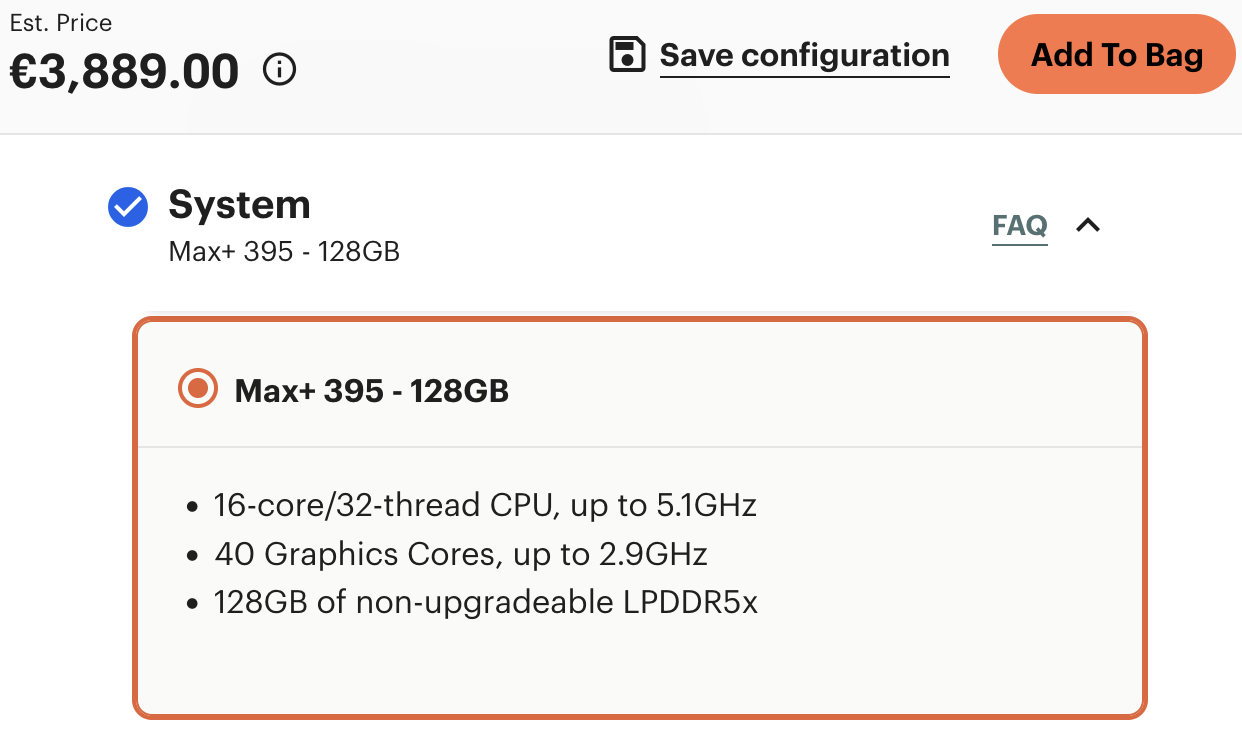
“You will never be able to afford the hardware to do so” I know people running a model equivalent to top end Claude from ~6 months ago on €3.5k hardware. Not cheap, not awful.
2/3 I would almost certainly start from someone else’s model release
Did they *train* the model on that hardware? The model has to come from somewhere, and last I heard, that “somewhere” was billion-dollar data centers.
Also, how the heck did they get that kind of hardware for only €3.5k in the middle of the chipocalypse? I'd probably have to pay that much just to assemble a competent gaming PC.

@bkuhn @copiesofcopies gosh it's like you actually know you're doing something wrong, prompting you to appropriate the language of queer liberation because you need to be sneaky about TRUSTING LLM SLUDGE

@bkuhn @copiesofcopies @cwebber I'm sure the fascist American companies write great policies!

@cwebber @bkuhn @copiesofcopies The lure of using GenAI regularly, and thus actively helping the destruction of the commons (among other harms), is especially strong when one finds a use case which is genuinely convenient or time-saving. Just because it saves me time doesn’t mean that it magically becomes harmless; that’s merely me rationalizing my use.

@bkuhn @copiesofcopies @cwebber So basically you asked a bot whose policies and leanings are controlled by its designers if you should allow the bot to control yours.
Yeah.. don't ask me for any money dude. I'll save it for people who can still think.
@argv_minus_one @bkuhn @copiesofcopies @cwebber @twipped No, they didn’t train it. I personally do not currently feel a need to train something.
As for the hardware:
If you didn't train it yourself, then you're still dependent on big AI companies to do it for you, and you therefore cannot shed Claude et al.
Note that there are no "attribution requirements" for "ingestion into machine learning models", that ingestion is an use of the work. The attribution applies to redistribution and/or derivative works.

@bkuhn @copiesofcopies @cwebber oh? Tell me how do you ethically advance the cause of fascism because that's a new one to me.
If the underlying philosopher of it regularly posting straight Nazi shit and one of the largest backers calling one of the two authors of the very Fasicst Manifesto wasn't enough to realize that's what's going on then check https://link.springer.com/article/10.1007/s00146-026-02862-9 and the 2022 book "Resisting AI: An Anti-fascist Approach to Artificial Intelligence" by Dan McQuillan.

I think maybe it was eventually resolved? I recall some discourse about maybe setting up a BSD violations.org domain similar in spirit to gpl-violations.org as well.
(This anecdotal tale brought to you by being around and doing the work, decades ago, and my frail human memory which seems more error prone than many computational forms of memory retention and retrieval resulting in imprecision when contending with recollection.)

@argv_minus_one @bkuhn @twipped @cwebber @copiesofcopies I am hopeful that future models will need less juice to run, and run more efficiently. I only see open-source home-grown models being the release valve to corpo AI

@cwebber the thing I like most about copyleft is that it potentially agitates corporations and yes it's insufficient for that use but AFAIK no licenses exist that were actually written with legal expertise that say "no corporations no profits"
I also agree with your appreciation of attribution though
@cwebber @bkuhn @copiesofcopies I'm using a local model in a harness to build a useless toy project but I couldn't ever take credit for it and if I ever posted it online it would be under "Authors unknown, copyright status unknown" ... imo there's nothing else you can do with vibe code right now
genai, bit ramble-y
@bkuhn @copiesofcopies @cwebber i think it can be reasonable to use unethical technology if there is no other choice, for example if your employer is forcing you to use proprietary software or genai; or your government (or bank) requires a proprietary app. however, this doesn't mean it's good. we should strive to minimize usage of these unethical things as much as we can
systemic issues generally are not solved by personal decisions, but many people going against a systemic issue can be a path to solving it. it's sort of a "when do a few pieces of sand become a heap of sand?" kinda situation. the way this informs how i do activism is that i try not to target individuals, and try to go against the wider issue
also, personal decisions can cause ripples if people are open about those decisions: i openly decide to avoid proprietary software and i openly object to all genai. i also openly decide to avoid consuming animal products. the act of doing this by itself may not do much, but i am setting an example for others, who can do the same, and together we are much stronger
i don't think it's possible to use genai to destroy it, imo the path forward is to completely reject it and band together with others that reject it. this is unethical and anti-social technology that has no place in the world

but regardless, i care very much that the wishes of those who do want attribution are respected. all of this useful source code, and all you want in exchange is for me to make sure you are properly credited? that request seems positively miniscule in comparison to what else one might reasonably want in exchange.
i think my own position is evidence that if people didn't care, they probably just wouldn't bother using licenses that required attribution.


@copiesofcopies @cwebber @bkuhn so to be clear: you are using a proprietary LLM to determine your policymaking approach?
surely, you can see why that isn't a good approach?

@cwebber @bkuhn @copiesofcopies i really "love" the "to figure out [how it affects things etc]" excuse. so many people stuck trying to figure out, no one saying they *have* figured it out, publishing a report and stopping the usage
I don't see how. Like I said, Moore's law is dead. My best GPU would take over 8000 years, as I recall, to train to the level of a frontier model.
I think this is right. It's already headed in that direction, just as hardware is being designed for the specific needs of LLMs.
It's frustrating for me to see so much of the free software crowd take a defensive refusenik crouch against the whole technology, when we could be doing what we've always done: build useful alternatives a few paces behind the rest of the industry.
Until now, it was merely a matter of writing the code. It didn't cost billions of dollars, only time and skill.
Microcomputers were my generation's great equalizer.
That is no longer the case. And that is exactly why the entire business world is madly obsessed with AI companies: their product is impossible, not merely difficult and labor-intensive, for ordinary people to replicate.
The AI-specific hardware you mention is, as far as I know, just a GPU that processes 16-bit floats and has more cores.
So yes, it's faster…but if it takes 2000 years instead of 8000 to finish the job, that still doesn't enable we the people to make our own AI.
It also doesn't get us the blanket exemptions to various laws that AI companies seem to have.
It's not even just impossibly time-, energy-, and hardware-intensive for we the people to make our own AI. It's *illegal* in a growing list of jurisdictions, such as California. Pols got duped by lobbyists into thinking LLMs can go full Skynet.
How do you make your own alternative to the thing when you'll be dragged off to the pillory for trying?


But I tend to default to BSD-3-Clause or MIT, and then sometimes put MPL-2.0, for example when I'd rather be sure I can use people's modifications. But typically would rather not go in the GPL territory (not a fan of several things about it, specially the restriction on different terms for linked code licences).
Also something I do is to just keep code at the license it's originally at, so like say BSDs can take the modifications back, which I see as like "copyleft in spirit".

@civodul @cwebber @copiesofcopies @bkuhn
This just sparked a thought in me, because I wanted to say "it's neither".
I think one big driver for people to end up in FOSS is being sick of bullshit and not wanting others to be able to control what one does with ones own computer.
The only way to do that proper is FOSS, but that doesn't necessarily mean that people would be all into the social collective stuff.
But, just because they want to be left alone, doesn't mean that they'd suddenly be hypercapitalistic with the goal of doing more faster.
I see a good amount of people that kinda hate both of these drawn extremes and are very happy that the clanker now exists, does the thing, shuts the hell up and leaves them be.
That group I think is rather underrepresented/invisible in the debate.
@copiesofcopies @Feral_3D @argv_minus_one
this was posted elsewhere and has been said in various ways in this subthread itself, but it's important to remember: a model doesn't come for free, and you can't rely on the same model forever, unless you have some criteria for "good enough" which no one ever seems to have. if there's supposedly a model that's as good as claude was 6mos ago, is that really enough? are you willing to say "yes"? because as far as i can tell, it's never enough, and the cycle won't stop until we make it stop.
how much are we willing to sacrifice that we have no real right to sacrifice?
The cost to build an LLM
1) the quality of life for the people living in a city near quality fibre
2) more computer chips than we can build
3) enough power to be noticeable in a graph of all human power consumption
4) The lives of a few thousand people in the global south too desperate to not take a tagging jobThe cost to build a "small ethical model that runs on your phone"
1) An up to date LLM
https://convenient.email/display/2c704a81-2069-7180-60a2-a16295276096
Sure, and some version of that list can be made for your computer and your phone. Is the scale of impact so much higher for LLMs that the ethics are fundamentally different? Or if you're honest, do LLMs get a boost over the line because they're capable of doing something you've constructed your identity around being good at?
That's a false equivalence, and I'm honestly shocked you'd make such an absurd comparison.
My computer was manufactured nearly 10 years ago, and the total cost to do so was a *rounding error* compared to the total cost to make an LLM.
@argv_minus_one @copiesofcopies @bkuhn @twipped @cwebber are we kicking around any other ideas? Giving up and not trying because it's hard and expensive sounds like a bad plan long-term.
I think public libraries should build their own llm. The opportunity is there.
Again, false equivalence. LLMs most certainly do not serve millions of users per server.
A moment ago you were talking about the cost to make an LLM. Now we’re talking about the cost to host one?
You have made the argument that LLMs are too costly (in various dimensions) to be ethical. I’m saying that the same KINDS of costs are involved in other technologies you have deemed ethical enough to take part in. So you have drawn a line: on one side is your laptop, on the other is the LLM. What was the process by which you draw this line, if not plain fear of the technology?
For a technology's use to be ethically justified, it has to deliver a net good for society.
For example, a laptop enables its user to chat with faraway people, learn new things, play fun games, store information microscopically, and so on. The cost to make and run it is not zero but it is not particularly high. So…seems like a net good.
So far, LLMs have delivered…plagiarism, fraud, psychosis, job losses, and economic collapse.
So I guess I draw the line at my laptop. 🤷♂️
why would you expect that it would do anything other than bias you towards allowing it?
the corporate interests of those who trained the LLM are in favor of this outcome. you cannot expect it to to do anything but lead you in this direction, regardless of whether it is correct.
by deciding to allow it to help you, you have already forfeited making the decision.
if the "average decision" is good enough for you, then whatever, i guess.
but isn't the Software Freedom Conservancy a bit more important than that? isn't part of the point not to just blindly do the same thing everyone else is doing?
i do not have software freedom in a world where anyone with an LLM can take my software from me and use it without my permission by laundering it through a bit of matrix math, so that they no longer have to obey the attribution requirements, or anything else they decide they don't like, such as the entire contents of the GPL.
your decision here does not make me feel like the Software Freedom Conservancy is fighting for my software freedom.
so, what you are doing is allowing Anthropic, the corporation, into the room, and giving them a share of your seat on the board, and a leading voice, in the only policy that could reject their interests, by outsourcing your policy decisions to them.
i do not trust Anthropic to forward the interests of the SFC.
i also do not trust anyone who lets a corporation like Anthropic make decisions for them on behalf of such an organization.

@cwebber @bkuhn @copiesofcopies
"local models" are mostly for "localwashing"; people like to bring them up as an alternative that nobody uses
that, too, but consider: almost all these “local models” are still trained like a big model or from those, with all the ecological, ethical and slavery aspects that come from it (this is also a form of “localwashing”); truly self-trained models are, by necessity, so much smaller… (I think that basically anything you interact with using human language is out)



 :EA DATA. SF:
@civodul @cwebber @copiesofcopies @bkuhn
Surely, this is one of the primary reasons genAI was released.
@jrdepriest I only sort-of agree. it was released to impress people as an advertising stunt for an evil sex cult. it got trillions in funding afterwards to enclose the commons
@cwebber I do, I even argued along these lines years ago already:
I publish under permissive licences, where the attribution requirement, not even as onerous as in CC-BY, is pretty much the only one; as such, failing to adhere to it should weigh much more as failing one of the fivehundred or so clauses in, say, the AGPL.

@bkuhn @copiesofcopies @cwebber
Proprietary technologies are one thing.
Weaponized social engineering torment nexii unleashed by megalomanaiacal technofascists are quite something else....
@bkuhn @copiesofcopies @cwebber to add on to what others have said: those models are not unbiased, and I would not be surprised for a variety of reasons if the text that was outputted was subtly biased against policies that would allow FOSS to thrive. We are influenced by language: even if you aware of this bias, it can be hard to mitigate it.
The time that the grok model was outputting text about "white genocide" and "being mechahitler" was just an example of someone putting their thumb too heavily on the scale, so to speak; they're more subtle at Anthropic. I would be very cautious about using text generated from a corporate LLM to influence policy decisions (in fact, I would not do it).


@linear @copiesofcopies @cwebber @bkuhn
I think many people feel the same about AI just scraping everything in sight.
I agree. I think it's completely immoral to create *new* LLMs at this point in history. I believe we should spend 3-4 years just using the ones that exist to figure out if there is use in creating new ones.
Unfortunately, #Anthropic, #Microsoft, #Google, #OpenAI, and thousands of other capitalist initiatives don't care what I think.
I live in the real world, not the one I wish I lived in.

@bkuhn @ariadne @copiesofcopies @cwebber Sure you can.
"Don't use it." is the reasonable policy.
Let's pretend instead the "something" were "copy-and-pasting leaked Windows code into your FOSS programs".
You're not going to try that out in order to figure out what the "reasonable policy" is.
You're going to advise people not to do it.
The thing you're talking about is, functionally, almost exactly the same.
@bkuhn @cwebber @copiesofcopies How convenient!
It seems like you haven't read carefully what I've talked about and what I'm working on.
I know you're frightened for the future of software freedom; I am too.
Most folks who think the GPL was magically saving our software freedom just don't realize that 95% of the users of GPL'd software in the last 15 years have had a violating device/system and never had software freedom to begin with.

@bkuhn Respect for being open about it here, where it is intensely unpopular.
I don’t care about “proprietary.” What about intellectual property theft? What about damage to the environment? What about diversion of SO much resources away from things that help people and into things that help investors?
Every time someone uses it, especially as a technology leader who knows better than most, they signal that all those trade-offs are acceptable for the trivial, tepid benefit of writing bland text faster. And the benefit of firing people. And the benefit of wealth aggregation.
In my position, I have the financial means and the knowledge to fight against it. If those of us who CAN choose not to use it, instead choose to support it, how can we expect anyone else to make the pragmatic, better-for-everyone choice?
Nobody gets to hide behind “this is my personal choice and nobody should tell me otherwise.” If a person set their trash on fire in their yard in order to dispose of it, their personal preference doesn’t matter. That’s not ok. Burning fossil fuels to power the most catastrophically inefficient technology ever made is not a personal choice. Climate change affects generations to come, not just people alive today. AI today accelerates climate change. It’s super simple and absolutely directly causal.
Can anyone present a plan that would even have a 40% chance of getting 15% of the software developers in the world to boycott LLM-gen-AI?
If someone comes up with such a plan, we should all work to make it happen!
In the meantime, I'm going to try to subvert capitalism by using any tools that I've got in front of me, even those provided by capitalists.
That's what FOSS has done since the 1980s. I guess maybe I'm just old-fashioned? 🤷

@bkuhn
Everyone else has been nice and informative to you, so let me just add that you suck, your policies suck and you deserve the worst! Hope that helps.
You're describing more or less what I've been working on the last three years, albeit with a different framing.
I'll keep working on it!
@bkuhn @mxchara @copiesofcopies regardless (I haven't followed the rest of the convo), really not a good look to phrase that as coming out. using AI is a choice and not an identity, and the repercussions are not remotely comparable.
You're not going far enough back in FOSS history here. Capitalists have been forcing us to answer that question for at least 15, possibly 20 years, and we've been answering it wrong because of the oppressive boot of Big Tech on us.
We must keep doing what we've been doing all that time: trying to undermine capitalism even though we have to live under (almost surely) for the rest of our natural days.
You make a very good point, and I've edited the original post to remove that phrase! I apologize for using it initially.
The reason I used it is that I expected I'd face substantial ridicule, and preparing for that reminded me of my own coming out as queer, but you're absolutely right that it conflated choice and identity and that was inappropriate.
I hope you can accept my apology!
as a thought experiment, consider whether you would change your behavior if it turned out that every request to Anthropic was outsourced to a "call center" somewhere halfway across the globe, where a bunch of people were trained by Anthropic to always provide similar responses and pretend that they are an AI. would you still be so comfortable with using this?
(leave aside the fact that this sort of thing actually sometimes happens in real life, with real "AI" deployments)
@linear
Every poor person I know uses LLM-gen-AI more than I.
e.g.:
1 of my best friends is an artist who — after 20+yrs of min wage jobs — decided to pile up the student loans, get her BFA to become a working artist.
Some of her #LLMGenAI incl: editing her grant applications, correcting grammar on copy for signs about her shows, sprucing up emails to colleagues.
I urged her to not use it so much, & her response was to tell me to check my privilege. She's right.
Cc: @copiesofcopies
please, do keep up the good work, and ignore my own foolish mistake in judging you too quickly.
I will continue as part of my work to sustain your right to be able to work in the computing field and refuse to use any LLM-gen-AI if you have an objection.
I have been hoping someone for decades would do widespread unionization of software professionals. One demand that I believe such efforts should include is a non-retaliation policy against software workers who choose to *not* use #LLMGenAI.
You should have an inalienable right to *refuse*.


@bkuhn @ariadne @copiesofcopies @cwebber
I'm not sure about the logic there? 🤔
Banning of asbestos isn't done by people who use asbestos. It's done by people who've read the reports on its horrific effects on innocent bystanders and want nothing to do with it.
Banning asbestos hasn't led to any crime waves?
(I agree prohibition of alcohol was a disaster that did more harm than good though.)
While I see why you picked your analogy, no analogy is perfect, but I maintain that mine is more apt than yours.
In my experience, **use** of LLM-gen-AI is a bit addictive & causes serious harm for some but is valuable for others.
**Production** of LLM-gen-AI is a different matter, but banning it won't work so we should seek serious and strict regulation.

@bkuhn I didn’t see any citations on the claims you’ve made in this thread.
How come that expectation only cuts one way?
@bkuhn @copiesofcopies @cwebber
No hyperbole.
"AI" in its current form is primarily a weapon. It's a signal jammer flooding our communications with noise and poisoning the wells of information, to enclose the digital commons while establishing vast levels of surveillance and propaganda. Devaluing labor, eroding skill levels and cognition, devastating the arts, humanities, and science, while seeking to replace human relationships-- including, terrifyingly, therapy!-- with artificial fascimiles with an unaccountable technofascist agenda. Oh, and destabilizing the global economy.
It's a weapon. Any other (messy, limited) usefulness it has around the edges are window dressing.
@copiesofcopies @bkuhn @ariadne @cwebber The legal risks are less just because there's less risk of the infringed parties being able to prove themselves the infringed parties or having the financial resources to litigate it.
But in terms of how it affects the ability of parties who are not willing to play Russian roulette with supposed FOSS they want to distribute, it's the same thing. You're making something that's nominally FOSS, but not actually.
@bkuhn @copiesofcopies @cwebber can you explain your reasoning on this, please?
> One can't suggest useful policies regarding something they boycott
I genuinely do not understand what you mean.
@bkuhn @copiesofcopies @ariadne @cwebber That question has utterly no relationship to the topic at hand.
The question is not whether the people you're infringing against can afford to sue you, but whether the people who want to be able to use your nominally-FOSS software under the license you claim is has, but who do not want to be infringing *regardless of whether you think the risk of them getting sued is serious*, can do so.
And if you incorporate slop, the answer is a hard no.
Just imagine for one second, this tech in the hands of somebody like Goebbels. Psychological warfare can be worse than missiles-- and this has both.
Read any of the depraved screeds these Epstein-partygoing Lex Luthor wannabes have been spouting, the TESCREAL philosophies that people like Timnit Gebru have been trying to warn us about. Stuff like the Dark Enlightenment, the Techno-Optimist Manifesto, the Network State, etc etc.
They're overt eugenecists out to destroy democracy, and they're not even trying to hide it.
I've been organizing locally for years already, thanks.

@bkuhn Thats worrying that you need/choose to use an AI for such things.

@bkuhn @silverwizard @copiesofcopies @cwebber @ossguy
What an excellent example!
It is almost certainly built on wage theft if not outright property theft, loaded with hidden surveillance equipment installed by an organized crime ring, built well below minimum safety standards with no emergency egress, the elevators move erratically and often arrive on the wrong floor, and an endless stream of lawsuits and property disputes await...
I am not sure "boycott" is exactly the right word!
@tristen
I suppose I'm just old fashioned, but I don't know how to research what a technology does, why it does it, and how we prevent it from harming people without using it.
I have been through this before. I really didn't want to carry a pocket-computer (what most people call a “smart phone”), but I started carrying one & worked with @copiesofcopies to try to build 1ˢᵗ FOSS firmware for it because I expected a lot of people would use them eventually & FOSS activists needed to get ahead of it.
@bkuhn @copiesofcopies @cwebber do you think that people engaging in a boycott A. have never used the technology, and B. regardless of whether they have or have not, do you believe them to be ignorant of the technology at hand?
Your comparison to traffic is apt but probably not in the way you meant: a system with massive amounts of externalities forced upon society by well funded sources. People in cars are not the only ones impacted by the traffic laws: the people living and walking in the area bear the long term consequences of car centric infrastructure.
But all of this is really... unrelated to my original point, which is that the model you're using to generate text about a policy has two sources of bias: 1. The training data, which is filled with discussions of FOSS and corporate power that is almost certainly biased in favor of enclosure (as that is where we are at the precipice of now), and 2. There is nothing stopping the corporate entity controlling the LLM from refining the model to push language and text that is biased in favor of the corporation. We've already seen that happen.
Perhaps a good question to ask is: would you ask Zuckerberg, Musk, Altman or the Anthropic CEO what you should do with regards to FOSS? Because that is what you're doing.
For which part?
Moore's law being dead? You can run modern software on 15-year-old computers. In the 1990s, trying to do that would fail miserably. QED.
You being subject to copyright? I mean, you're welcome to test that hypothesis yourself if you want, but I wouldn't recommend it.
You being prohibited by law to recreate Claude yourself? Here are some examples of such laws:
1. https://en.wikipedia.org/wiki/California_AI_laws
2. https://www.govtrack.us/congress/bills/119/s5493
@bkuhn There are many, many papers, posts and articles about how AI works and the harm it is currently doing. Asking an AI, the thing doing the harm, seems silly to me. Its in the AI company's best interest to keep you using it and NOT to sway people off it.
@bkuhn @silverwizard @copiesofcopies @cwebber @ossguy
I was literally talking about the reasons why I would not recommend using that building, based on who built it, and their actual past history with construction of... buildings.
I still think it is a great example, and the parallels are right there.
@bkuhn My apologies. I must have misread "I suppose I'm just old fashioned, but I don't know how to research what a technology does, why it does it, and how we prevent it from harming people without using it."
I took that as, you're using AI to find out these things.
@bkuhn @copiesofcopies @cwebber Perhaps you should read my post which has shown many ties between AI and fascism but did not call you a fascist. But since you insist: "Wenn ein Nazi am Tisch sitzt, und daneben zehn andere, die dasitzen und mit ihm diskutieren, dann hast du einen Tisch mit elf Nazis."
@bkuhn @silverwizard @copiesofcopies @cwebber @ossguy
Clearly I am too diplomatic to reach for vitriol, but I most certainly feel severely disappointed and betrayed and just plain tired of it all...
I think you will continue to be baffled until you can get a more deep sense of why people are so damned angry. There is something truly genuine and real there.

@bkuhn @chx @copiesofcopies @cwebber I guess you banned me before I could finish the thread. I had two concentration camp survivor grandmothers. I do not use these words lightly. Perhaps you didn't know what you are pushing -- but now you do and you need to live with this knowledge. What does it matter to me that you are banning me from your little server when you are helping this darkness to engulf the world again? This is the company you keep now and you know it.
@bkuhn @silverwizard @copiesofcopies @cwebber @ossguy if Trump was benefitting, then no, the activists should not use it.
Look, I'm anti-AI but not strictly, I think there are plausible use-cases worth exploring and I use it here and there in my day job. Given all of the considerations, I actually think the SFC policy on AI is not terrible (I think it's way too late but that's a different issue)
What continues to bother me is that the framing of the topic from SFC just makes no sense to me. There's all this activism against big tech, people are hungry for alternatives, these are people who believe so many of the things we believe and could be our allies. We've never had so many people who hate big tech as we do now because they see it as the existential threat it is but SFC's framing and work doesn't speak to that and comes off as almost minimizing of that position.
@bkuhn @silverwizard @copiesofcopies @cwebber @ossguy
Try to build a data center in Wisconsin and tell me the angry people weren't effective activists. Try to put a new Flock camera up in Wisconsin and tell me the angry people weren't effective activists.



@bkuhn @Photo55 @joeyh @cwebber @trashheap I've heard the "a-patchy" story repeated for decades. Of course it was just racism 🤦
@copiesofcopies @cwebber @bkuhn but my point is that the alignment of the proprietary LLMs is not neutral, and thus depending upon them to craft your own policymaking agenda is likely to yield unintentional pro-LLM bias.
because the LLM models want to keep users engaged.

@bkuhn > I don't know anyone (at least, anyone who is serious about #FOSS policy & how its impacted by LLM-gen-AI) who says “nobody cares about attribution requirements”.
IME, the overwhelming majority of folks who choose to license their work under MIT, ISC, or 3-clause BSD
1) Do not care about attribution
2) Are likely to be *surprised* that the license includes an attribution requirement. They knew they didn't care about copyleft, and the common wisdom was if you don't care about copyleft that's the license you use.
And a much smaller but still substantial chunk of GPL choosers who don't care about copyleft or attribution, but similarly chose the GPL because the common wisdom was that's the license you use for FOSS.
So sure, it's sort-of tautologically true that "nobody who is serious about FOSS policy" would say nobody cares. But it's also sort-of true that "folks who are serious about FOSS policy" are rounding-error compared to the number of people publishing FOSS
It's an open question currently if there *are* any tasks that an LLM-gen-AI can usefully compute on that require latest-greatest.
Given how much harm is being caused by retraining and/or building new LLMs, a moratorium on (re)training commercially net-service-deployed LLMs for at *least* a year or two is correct policy (IMO).
Sadly, regulators aren't paying attention enough to have a chance at this.
semantics about slop
produce code that's far from slop
i would say perhaps code that doesn't look like slop or doesn't look sloppy, but if it is generated by an LLM, it is slop, and i think it is really important not to cede that point regardless of how impressive the output appears and even regardless of whether it happens to be good or correct in a particular instance. i will say more if you want, but my interpretation is based on what i've heard and read from linguistics professor emily bender (who is here on fedi too)
(in terms of the world looking different here than outside, i am probably proving your point and you might unfortunately be right though, but i also know that the media is pushing false and inflated narratives including about the prevalence of use, capabilities, and sentiments of users. it's not all false and many of us know people who are either true believers or deep down the pit, but i suspect it's not as widespread as we're being made to believe or to extrapolate based on a handful of personal anecdotes.)

AI companies do not derive their shareholder value from what the current models do, but from the vague promises of what future models might be able to do.
Thus, a true moratorium on training new models would instantly pop the bubble, as it would expose the lack of economic viability.
Om the other hand, a moratorium on releasing new models would preserve and prolong the bubble, as they could go on promising AGI without releasing anything.
That's interesting. Do you think that we could convince regulators to do that compromise idea you have?
I think the nuance between the two, which would not be lost on those who have a deep understanding of what's happening, would be difficult to explain to regulators.
Meanwhile, these companies have no reason to compromise about anything in the current regulatory regime. 😕
@bkuhn @copiesofcopies @cwebber You do not need to smoke a single cigarette to know what tobacco policy to set in your house.
@bkuhn @silverwizard @copiesofcopies @cwebber @ossguy I don't think people see a plausible or convincing way in which SFC's AI work is fighting big tech. I think it just comes off like one more way they're being let down.
@bkuhn @silverwizard @copiesofcopies @cwebber @ossguy I am non-violent as well, that's not what I mean by "fight".
@bkuhn @silverwizard @copiesofcopies @cwebber I don't think everyone who uses LLMs are the enemy! I'm one of them!
Right, so, that's why I am surprised your position is that I (and/or all of SFC) is letting you down!
I truly would organize an LLM-gen-AI boycott in the industry if I thought it could work. I actually tried to get people to boycott proprietary software when I started as a Free Software activist!
So many ppl already use LLM-gen-AI. *Someone* who is ethical & cares about software freedom needs to produce guidance to reduce harm.
Who else will do it?
@bkuhn So like, separate from the general discussion about OKness of using llm-gen-ai: Getting DDoS'ed by ClaudeBot is a thing that I suffer from and causes me lots of stress.
(IDK if Claude has a free tier, and/or if it's what you're using, which would absolve you of the following) I'd prefer if folks didn't contribute to the "brick fund" of the guy actively throwing bricks at my house? I've successfully put up netting in the yard (a combination of Anubis, Nginx rules, and nftables IP blocks) so it's been a while since a brick actually made it to my window, but still...
One of the recommendations I'm likely going to include is to severely limit the amount of web searches that you ask LLM-gen-AI to do on your behalf. You can control this as the user, fortunately.
Another recommendation is to not immediately jump to the new models when released (since the web searching from Anthropic servers is going to be for retraining, not specific user requests).
This are just ideas right now; I'm still refining them & discussing them with other experts.
No, we could not, and it wouldn't matter if we could.
The AI bubble have probably entered the popping phase of the mega-boom-bust cycle. The phase where history just have to run its course and there is very little anyone can do to alter its course.
It's like the demolition of a smokestack. Once the foundations are blown up, the only sensible thing to do, is to stay sufficiently far away ... and perhaps stock up on popcorn while watching.
I think you're right that the bubble will burst, but the boom-bust cycle often takes excruciatingly longer than any of us would like.
But, while I will be glad when the bubble bursts, I don't think there is anything to celebrate about the damage caused to FOSS by the capitalist manipulation of LLM-gen-AI.
I've used "fight" before myself to mean "resist", etc., but I've successfully eradicated that usage.
It's ultimately a violent word, and it gets used in politics a lot too, but I think that also is a mistake that politicians should fix too.
@wwahammy
I don't want to fight anyone due to my commitment to non-violence.
I wish I could convince you in the “meeting people where they are” principle is well-applied here.
But, if everyone who uses LLM-gen-AI is part of the problem, I can't convince you.
I agree the initial recommendations were late, & the follow-ups are overdue.
I don't know how to build a broad coalition when there are so many in the FOSS community who see anyone that uses an LLM-gen-AI to be just as bad as Anthropic, Microsoft, Google, etc.
It really is very much analogous to the harder-core Free Software attitude of old that anyone who uses proprietary software is just as bad as those that write it.
Yes, popping will probably drag out longer than most people initially expected. And the crisis afterward will probably last for what seems like ages.
And I'm wrong in stating that there is nothing we can do, because there are lot of things we should not do, because it will only make it worse.
But still, it is impossible to avoid a painful crash at this point. Perhaps we should put our energy into how to avoid another crash in 20 years?
@bkuhn @copiesofcopies @cwebber I reject the slopaganda premise that one has to, or should, use LLMs to understand them before judging them. It is valid to have an opinion on something based on observing the effects of other people doing it.
I also reject the premise that there is any good use case for a bullshit generator besides a bullshit job. There are doctors using LLMs to generate bullshit to fight insurance companies' bullshit; that's about the only good use case I've seen for this tech.
AIUI, "ClaudeBot" is crawler that scrapes everything for training, and "Claude-SearchBot" is the bot that does things on behalf of users.
I've never noticed substantial traffic from Claude-SearchBot.
(Likewise for GPTBot vs OIA-SearchBot/ChatGPT-User.)
For my disclosure: I use ChatGPT (at the gratis tier) on a weekly basis, largely as a search engine (because DDG and Google have gone to shit). Sometimes to-the-point "link to <thing>", sometimes having a conversation then asking it for citations which I go read, sometimes having in conversation then using terms from that conversation in a regular search engine.
From an environmental perspective, this is surely often a huge waste of resources compared to me spending a few more minutes banging my head against Google/Bing, but from most other perspectives (including a FOSS-policy perspective) surely this is one of the least-harmful uses of llm-gen-ai?
@be @bkuhn @copiesofcopies @cwebber As Pauline Kael put it, you don't need to lay the egg to say it tastes bad.
@bkuhn @twipped @cwebber @copiesofcopies Those were very different circumstances. FOSS was bootstrapped using proprietary software because it would be impractical not to. There's nothing impractical about refusing LLMs. Quite the contrary.
This is a great example of why you using the thing helps understand what its harm is. Before I used Anthropic's product, I thought that it would be doing a lot of web searches from the (dedicated & immediately considered untrusted) box it runs on & that would need reining in.
But it really does not do any unless prompted, & if you set "ask permission before doing anything", you see every `curl` & can approve/deny.
Sadly, many use it on "all approved". That's not acceptable.
@bkuhn @twipped @cwebber @copiesofcopies If you think we can copyleft our way out of LLMs, I think you've lost the plot.
@bkuhn @twipped @cwebber @copiesofcopies Is a clever new license worth your credibility? Because you're blowing it up right here in this thread.
I've talked about what I'm doing & why, not tried to prove something is true or not true about LLM-gen-AI.
I don't know for sure what is true or false about LLM-gen-AI yet. I, for one, am at Socratic Epiphany on it.
Only AI idea I'm sure of is that refusing to use LLM-Gen-AI & declaring anyone who uses it to be equally as bad as Anthropic, Google, Microsoft, etc. is not a useful approach.
@bkuhn @aud @cwebber @valpackett Advocating for boycott has a simple starting point: lead by example.
@bkuhn @twipped @cwebber @copiesofcopies What we need to fight LLMs is not a software license. What we need is clear leadership, unambiguously saying "this is bad, we reject it, it is not welcome here". You're failing to do that right now.
@bkuhn @twipped @cwebber @copiesofcopies You are coming across like an archetypal politician trying to find some nonexistent middle ground and pleasing no one when people are looking for someone to just say the obvious truth and stand by it.

@cwebber duh, foss isn't a great career compared to alternatives[1], so the core reason to do it finding fellow hackers and recognition, with modest money when you are lucky. if you skip attribution you devoid the knowledge graph from edges that connect people.
[1] unless you are not a hacker but an advocate with funding, that's a different kind of foss career with different incentives.
@bkuhn Who would the target audience for using such a license on their work be? Because it seems you're alienating the kind of people who might plausibly be interested in such a thing. I suggest you step back and reconsider your course. And apologize to aeva.
@bkuhn @copiesofcopies @cwebber I don't know if you're working for one, but in the post above you admitted that you're using an LLM produced by an openly pro-fascist company to write policies. Do you think their political stance doesn't have influence on their product?
@bkuhn So your argument is this thing that you are working so hard to defeat is on balance, not harmful enough for you to stop helping it along, because I who do not wish to help it at all, have not presented you with a library of evidence to convince you.
Welcome to Nazi Germany in the 1930's.
Sometimes you have to make choices without such watertight evidence, because you can see enough to know what's coming. Even when the evidence *is* there, people still choose to ignore it. I won't.

@bkuhn @philip How much more time do you think you'll need to come to a conclusion, Bradley? Before you'll "know for sure what is true or false about LLM-gen-AI"?
Is what Sam Altman himself said true enough for you?
> We see a future where intelligence is a utility, like electricity or water, and people buy it from us on a meter.
I have come to the conclusion long ago that capitalism corrupts and ruins everything it touches, including software.
But LLM-gen-AI systems from capitalists are by far not the only horrible technology they are peddling to harm people.


Dark patterns, DRM... I'm not even a fan of branding.
I find it pernicious that you can use the same sweatshops as Temu, put a logo on it with the same crap chemicals and all of a sudden sell it because you somehow market yourself better? And now I supposedly earn capitalist kudos by walking around with your brand like I'm a living advertisement? ... I don't get it.
I think I "get it", in the sense that capitalism is a disturbing optimization of the worst behaviors of humans (greed and power-seeking in particular).
I'm a fan of the quote I've often heard that in 500 years, humans will look back on capitalism in the way we look back at feudalism.
I am sure the serfs living under feudalism couldn't wrap their heads around a system that was radically different from that.
We as a species have the same problem with capitalism, I reckon.

@bkuhn @Photo55 @joeyh @cwebber @trashheap it is the only description of the name they were providing back in 1996: https://web.archive.org/web/19961028123412/http://www.apache.org/info.html
Probably earlier: this is the earliest capture of the page. That 2000 interview seems more like the retcon: picking the name purely based on the pun seems worse than appropriating it because you think it shows respect.
I obviously hope you aren't right. As I've gotten older, I've tried to be tentatively optimistic at the 500 year mark, even though I agree with you the 15 year mark is terrifying.
I'm a fan of this quote from Joseph Conrad's _The Heart of Darkness_, something like: “the human mind is the most dangerous thing because everything is in it.”
But that means there is good in there too.
@jamesh @bkuhn @joeyh @cwebber @trashheap
The UK Ministry of Defence maintains lists of names and two word phrases which are specifically intended to not relate to anything for which they may be used.
When certain events occur the responsible person pulls the next word off the list, prints it on a file, and uses that.
Operation GRANBY for instance[1]
Does or should the FLOSS[2] community maintain such a list and allocate the next line to the next project?
... [1]
@jamesh
I'm not an etymologist, but I was exposed to the formation of English place-names from an early age.
However, I don't think that's much of a pun.
To say that it is an example of #homophonia might be closer, as well as #etymologising it isn't quite a #homograph , since each construction clearly applies to the same meaning, the object otherwise known, but not pronounced, as httpd (etc).
I'd hesitate to label it _defiantly_ the process which _definitely_ annoys me, one word misheard.

@cwebber that is absolutely insane take from this person. FOSS only can exist because of attributions and proper observation of copyright law.

@bkuhn there is no such thing as reasonable or ethical use of slop, neither in foss nor anywhere else. Kbye.
That today's models are built in expensive data centres does not imply the same for all future models. Tech gets better, not worse, so eventually we'll do it on affordable hardware, Moore's law or not.
Also, free software lives on collaboration. Build a BOINC app to build a free model, wouldn't take as much time as that.
@Feral_3D @bkuhn @twipped @cwebber @copiesofcopies

@bkuhn @copiesofcopies @cwebber oh, so you're just another has-been in this field. got it
It's never appropriate to denigrate others when you disagree with them.
Also, among the many forms of discrimination in technology, age discrimination also exists.
A culture whereby the first criticism that we sling at person over the age of 0x32 in tech is a phrase like “has-been” bolsters that ageism.
I hope you'll check out the work of Christina Matz, a professor at Boston College:
https://www.computerworld.com/video/2139120/does-age-discrimination-exist-in-the-tech-industry.html
https://www.bc.edu/bc-web/schools/ssw/faculty/faculty-directory/christina-matz-costa.html
@bkuhn
I spent the day yesterday with a school teacher (my son is in marching band) and they couldn’t stop complaining (unprompted) about google shoving AI into their phone and google services. Then they complained about Amazon using AI for customer service. Regular people hate AI already. Only the investment class love it. We need to tap into that. We can’t get them joining the fight (or even seeing us as allies) by publicly declaring that we are using AI anyway and defending that use of AI.
I shouldn’t have to supply a perfect strategy for winning the war in order to identify some tactics that won’t work. I know that the winning strategy for fighting AI does not include the tactic of using AI. This is not complicated.
@paco, I apologize:
I used the rhetorical “you” ambiguously (now corrected). I don't expect you personally to propose a plan.
Sadly, after years of all of us trying to organize an LLM-gen-AI boycott, we have been unsuccessful & another plan is needed.
I agree that no-opt-out LLM-gen-AI is immoral It's mandatory part of clipping coupons now!:
https://fedi.copyleft.org/@bkuhn/117395131965191407
I'm glad many regular people hate LLM-gen-AI, but people with limited resources now also rely on it:
https://fedi.copyleft.org/@bkuhn/117459384935988770
@bkuhn @ariadne @copiesofcopies @cwebber Why wouldn't banning production work?
Anyone can knock up some moonshine in their kitchen, but a large model takes immense resources (hence the planet-burning data centres and book-burning data extraction techniques).
Oh, I do think a comprehensive, multi-year ban on production of new commercially marketed LLMs would make a big improvement of some of the worst aspects of this technology.
The “won't work” part is about the relevant regulatory regimes being too corrupt to implement and/or enforce such a ban. I thought this through a few months ago & couldn't even find a place to start trying to make it happen.
Cc: @copiesofcopies

Unfortunately it seems that the goal of the SFC has changed from fighting for software freedom since several years ago.

Anyway, I wanted to ask your opinion on OpenSolaris, Oracle buying Sun, and Illumos? and please don't disregard the answer because you don't care.
@anokasion
I do care about the FOSS project diaspora caused by Oracle's acquisition of Sun Microsystems.
I opposed the merger publicly at great personal risk because the now-defunct non-profit employer at the time was receiving grants from Oracle & pretending to be a neutral third party to the EU in the acquisition approval process.
I tried to do what i could to delay the acquisition to give forks time.
I am glad some forks survive.
Did you have a specific issue in this you're asking me about?

@cwebber @bkuhn @copiesofcopies
I do have a AI pilled PI collaborator who is using local models as some other work required high end GPUs so he had the hardware for decent performance.
However the incomplete information I've seen suggests the local models are trained by querying OpenAI or Anthropics work.
I suspect the only reason they're freely available is to steal market share from USA companies. If OpenAI and Anthropic goes down there probably won't be new freely available LLMs

@cwebber I release my code as copycenter and art as CC-BY, meaning attribution is my only requirement. I'm against IP, but we're getting further away from free culture when firms that jealously protect their weights and code make unauthorized remixes their whole thing. Let's see how they respond to a former employee vibe-copying their products.
Without IP, plagiarism is still fraud since you're misrepresenting both yourself and the real author. It's scientific misconduct not to cite sources.

@cwebber Agreed, attribution is the most important aspect of sharing things.
To be fair, to this European who's lived in a welfare state for the first 4 decades of his life rather than the church of capital that the US is,
We already do that.
@dotmavriq
- replies
- 1
- announces
- 0
- likes
- 0
@cwebber agreed, attribution is important.
Licensing means putting terms into unambiguous writing ("legalese") so that everyone else can see how your intellectual property may be used.
If we don't have attribution, we can't tell whose will we are supposed to respect.

@cwebber like it's just a baffling claim. if one didn't care about the attribution claim why didn't one use CC0 or BSD0 or zlib

@cwebber makes you wonder about the personal relationships (or lack thereof) of said FOSS person

@cwebber attribution is definitely very important to me and something I care a lot about preserving.
@bkuhn I really appreciate the apology. The rhetorical “you” is such a bear trap on social media and I step in it, myself, all the time.
So often the people with limited resources have been limited by society making bad choices. So I don’t call out how AI is a solution, because that makes it look good. I focus on their needs because that’s the problem.
Think about the lives ruined by AI in the global south: Africans classifying images and text getting PTSD from the horrors they’re paid to look at and classify. Trash pickers working in toxic conditions sorting ewaste for scraps. Why is their suffering an acceptable cost for the needy in wealthier nations?
@paco
Similar: billions of mobile devices — fueled by capitalism's inequitable & exploitative deployment — has done serious harm to the world's poor.
My spouse works in houseless services agency; they can't get companies to donate refirbs, so the agency buy & distribute cheapest (most likely to break) *new* ones; the clients can't access government services without them.
I wanna reduce these harm, but I'm realistic that mobile devices won't go away & capitalists won't help us make them ethical.
@bkuhn @wwahammy @silverwizard @copiesofcopies I *like* the idea of harm reduction, I think it's a good framing. But I don't think Conservancy's statement succeeded at it.
At a pivotal moment where there was an opportunity to *spell out the harms*, the position statement more or less put using genAI and refusing to use it as approximately "equally valid" positions. I think it did a lot to *normalize* usage in that moment, and so I'm still deeply frustrated by it. And that didn't and doesn't feel like harm reduction to me.
If you want to go about harm reduction, *at least* stick to only using local, open weight models! Kill that Claude subscription! You can't reduce harms while helping out the cartel.
@cwebber
That statement was a 1ˢᵗ step, not definitive list of recommendations. The statement says so, but if you find places where the document gives the impression a mic-drop was intended, I am sure everyone on the drafting committee would like to fix that.
The statement is also clear that the recommendations are listed in order of importance and “right to refuse” is listed first.
I do want to convince Anthropic users to engage with that system less harmfully. That's what I'm using it for.
Policy should indeed be written by only humans.
Humans have to study and review the systems they write that policy for.

@cwebber "Nobody cares about the thing they explicitly tell me to do," is a *wild* take. Attribution is by far the most important thing to me.
We'll do it on affordable hardware made out of what? Pixie dust? The party's over. Computers aren't getting any faster.
A BOINC app running on whose computers? For how long? At whose expense? Do you have *any idea* how expensive those AI data centers are, both to equip and to operate? https://isaiprofitable.com/
And where's the training data coming from? Not even Anthropic can afford that without breaking the law.
I can't help noticing you're also continuing to gloss over the extreme expense of regulatory compliance.
And you can't distribute that via BOINC. Everyone running the BOINC client has to separately pay for regulatory compliance, submit to inspections of their premises, and so on.
Distributing the cost of AI via a system like BOINC is a pipe dream. Even if it were technically feasible, government regulations will not allow it.
And yes, tech *is* getting worse.
You have, I assume, observed that people are being forced to go back to spinning hard drives, DDR3 RAM, and basic integrated GPUs? I never thought it possible myself until recently, but computers are literally getting slower.
Also, faster computers require more electricity (both for computation and for cooling), and electricity is getting more expensive, too.

@cwebber Repeatedly over the years. Earliest I can immediately find published by me on the topic is 2012 "We should focus on attribution. Claiming credit for the work of others is plagiarism. That's NOT the same thing as copyright." https://landley.net/notes-2012.html#31-05-2012
@cwebber I know I've said a lot more on "attribution vs ownership" over the years (https://landley.net/notes-2017.html#27-03-2017 says it was a section in my 2013 ohio linuxfest talk but I'm not finding it in the outline and not re-listening to the old talk right now, I may have meant a different talk).
@cwebber In 2018 there was ""The internet is really good at finding plagiarism, and between github and archive.org proving you published first and the thing is yours isn't usually a huge deal. The larger cultural issue is "attribution" vs "ownership", but legally demanding attribution leads to visible watermarks on photos and such, when what you really want is not plagiarising"
https://landley.net/notes-2018.html#28-09-2018
It's a pity Google can't find this sort of thing anymore and I"m reduced to grepping my blog.
@cwebber Anyway, Bradley and I have famously disagreed on basically everything since the busybox days and this is just one more to go on the pile...
(Let's just say I have not found Bradley to be a reliable partner in license enforcement, ala https://landley.net/notes-2013.html#13-02-2013 and of course he's got me blocked on here...)

@bkuhn I'm kinda gobsmacked by this TBH. I agree that it is reasonable to use proprietary tech to build non-proprietary, etc. (of course) but I've always known you to have a pretty high bar against using proprietary tech.
All other considerations aside - and that's a lot of considerations - ISTM that there's nothing Claude offers that you can't do with your brain, though slower.
And Anthropic's moral compass is... um, lacking. It makes some of the late 90s and early 2000s tech shenanigans almost seem quaint.
This kinda broke my brain, really. I wouldn't have been shocked to hear that you'd tinkered with Claude just to see whether its output was violating licenses, etc. But kinda shocked to find you'd actually use its output in a codebase.


@cwebber Agreed. To date, "people" haven't cared much about attribution, sure, but when you have project after project shouting that only their leadership or major contributors can have opinions that matter (and everybody else can "just" fork the project...and let the terrible leaders do what they please), it shows that anonymity hasn't done the projects, the movement, or the users any good.
@bkuhn Thing is, even though you could be at odds with Raymond or with Red Hat, you could still view them as objective allies because in practice we were all contributing to the free software commons that we saw as artifacts for user empowerment.
But that’s no longer the case: big tech has been freeriding, and now they’re building their ideal of free software without free software activists—destroying the commons we built as they move forward.

@bkuhn @copiesofcopies @cwebber
You have outsourced your decision-making process to a robot owned by corporate tech.

@bkuhn @aud @copiesofcopies @cwebber
> One can't suggest useful policies regarding something they boycott.
That is an exceptionally strange position to take. By that logic, gun control policy proposals are manifestly incoherent because they largely come from advocates who do not regularly shoot guns — one can disagree with gun control policies on the merits, but requiring advocates to regularly operate firearms would be ludicrous.
Why do you consider that to be reasonable in this case?

@xgranade @bkuhn @aud @copiesofcopies @cwebber I guess all of us who don't own slaves can't participate in discussions about slave-owning policies either.

@bkuhn @copiesofcopies @cwebber I don't know you, and you don't know me (Hi! I'm Kevin. Long-time open source programmer.), so I am going to be brief and respectful:
Research is good. Trying things is good. But most LLM technology has myriad concerns that stretch far beyond the ken of proprietary ownership, and should be factored into all usages.
In my opinion, this makes it incompatible with Free/Copyleft software. The costs are too great.


@ariadne @copiesofcopies @cwebber @bkuhn
The proprietary LLMs are absolutely going to give output biased towards continuing their use. It feels like asking the foxes how to approach policy for hen house design.
Most descendants of the Apache tribes don't seem to mind.
@Suiseiseki
> Most descendants of the Apache tribes don't seem to mind
That's also a good point (ie arguably, not necessarily conclusive). Have they been formally consulted on this use of their tribal name, with a 'no, please change it' being respected?
When software projects from Aotearoa (and other organisations) use words from Te Reo Māori in their name, like Koha and Mahana (both Free Code) this is generally the etiquette that's followed.
(1/2)
@strypey IIUC, the timeline:
A. A non-profit called “Natives in Tech” (not affiliated w/ a specific tribe,AFAIK,but a general advocacy group),asked Apache [sic] Software Foundation to stop using that name: https://www.theregister.com/software/2023/01/11/native-americans-ask-apache-foundation-to-change-name/1284799
B. Apache [sic] Software Foundation did a ≈3 year private process to build a response.
C. The response was woefully in adequate:
https://fossforce.com/2025/09/asf-retires-indigenous-imagery-but-keeps-apache-name-for-now/
D. Natives in Tech became less active during the period (due to lack of funding, maybe).
It stands out like dog's balls when they don't consult Māori too. The National Library did, and their Te Reo Māori name is Te Puna Mātauranga, which can be translated as 'the wellspring of knowledge'. A gorgeous name, in both languages.
In contrast, I'd very surprised if St John Ambulance asked kaumātua (elder) what their Te Reo Māori name ought to be. They went with 'Hato Hone,' which is an ugly-as-sin transliteration of their English name 🙄
(2/2)

@bkuhn
> A non-profit called “Natives in Tech” (not affiliated w/ a specific tribe,AFAIK,but a general advocacy group),asked Apache [sic] Software Foundation to stop using that name
I can't pretend to know sod all about intertribal politics in the US. But based on what I know from liaising with iwi in Aotearoa (among other roles I did 2 years as a cultural officer on the Council of Permaculture in NZ), I wouldn't put too much stock in this.
(1/?)

@cwebber @bkuhn @copiesofcopies It also sounds a lot like building a house on morsh/rotten with the expectation it will stand still.
Using closed source software a service software to ask them about Foss is like asking someone who is against something about that thing, i.e. terf about trans people.

@teajaygrey @cwebber There's reputedly a few cases from many years ago where people removed the BSD license from code and submitted it to Linux in the mistaken belief that Linux would only accept GPLed code. Most were detected pretty quickly and the BSD license reinstated. There's plenty of GPL code around that is modified BSD code so I doubt any of the main Linux developers would have had problems with the BSD license and the GPL existing in the same source file.
In the 1991 USL vs BSDi lawsuit, AT&T subsidiary USL claimed that BSD contained some AT&T UNIX code, The University of Southern California Berkeley countersued as System V contained significant parts of the BSD code with the copyright & license removed. At that stage it seems nobody considered that as UNIX/32V, an ancestor of 4BSD, was published without a copyright notice it was, under the laws at the time, public domain ... this would become important a decade later. When Novell acquired USL, it quickly made a settlement of the cases with Berkeley.
At the beginning of 2003, SCO started lawsuits that claimed that there had been "misappropriation of its UNIX System V code into Linux". When they were eventually forced to disclose which code was involved, some was BSD code (With author & License removed,), some was from research UNIX via the public domain UNIX/32V and possibly 4BSD, some itanium related code was written by IBM and incorporated in the System V based AIX and also donated by IBM to Linux, and some had been released under the GPL by SCO when it was a Linux vendor named Caldera.
About the only three significant bits of code that SCO could still claim to own were the Berkeley Packet filter, from BSD so not theirs, some SGI specific code that was never released in a Linux kernel and the Itanium code mentioned above.
The final nail in the coffin was a jury determining that Novell and not SCO owned the UNIX copyrights thus making the Itanium issue moot .
Ooops
Then again, I was using various versions of UNIX before Linux was a twinkle in Torvalds' eye and still think that there was a lot of unfortunately overlooked sanity in the UNIX Haters' Handbook and was unequivocally in the camp of Andrew S. Tanenbaum back during his chastising of Linus on Usenet for reinventing the flat tire of a monolithic kernel, particularly in the 1990s. Not to suggest that NeXT with mach were my preference (they weren't and still aren't and even Apple finally acknowledged at least enough to put L4 in their Secure Enclave in more recent years) so long ago.
Nonetheless, my personal theory is Linux became "popular" because of that USL/BSDi lawsuit and it wasn't great yet at least it could run GCC, and so decades of legacy code could still be ported without much fuss. When Silicon Graphics made me a job offer in 2016 (arguably, decades after I stopped caring about them) they had mostly devolved into a RHEL VAR. ;( Long gone were their days of IRIX and meaningful innovation (and I'll omit my own longer winded skunk works skullduggery with my friends at nps.navy.mil while we were still teens in highschool when we were getting snuck into SGI labs after hours and I was fixated on microcode level optimizations and managed to talk SGI corporate into selling me an Indy without RAM or a HDD in hopes that my parents would pay for that as my college computer only to have my sister get married that summer and my college computer budget turning into her wedding instead. I ended up being forced to work as a janitor for my dad's apartment complex turned into low income condominiums and scraped together enough to piece together a very long in the tooth by 1994 Amiga 2000 at least and ran AmiTCP [which was an approximation of a BSD userland of sorts] at least!)
p.s. convicted monopolies and attorneys seem to be invariably: evil tyrants who do nothing besides punch down
CC: @cwebber@social.coop

@bkuhn @cwebber I'm curious what "enforcement hook" means. Isn't it just a matter of how much money (which ~ turns into labor) is behind something, whether or not it gets enforced well?
I've always felt it is still necessary that we fight to make the law make sense even if enforcement remains a difficult problem that might never be resolved...