

May blue be the colour of the day!🌊
A stunning #Roman ribbed bowl, fully intact with little to no wear, found in Nijmegen, The Netherlands.
📷 me



RE: https://m.ai6yr.org/@ai6yr/117549575671327171
His team also encountered a man wandering around at a trailhead with an AI-generated map that showed prominent features on the wrong side of a nearby mountain.
maaaaaannnnnnnnnnnnhhhhhh
RT: https://m.ai6yr.org/users/ai6yr/statuses/117549575671327171
Systems programming be like:
1. The system (hardware, software, or application) needs flexibility.
2. Designers defined a set of minimalist primitives to meet the original requirements. "Keep the possibilities open, but don't overengineer it."
3. System succeeded, usage greatly expanded.
4. System needs to meet new requirements, but the baseline is fixed.
5. Developers start inventing many Rube Goldberg machines for the simplest operations. Want to control temperature? Use an opamp to fake an error signal to a voltage regulator chip. Branch predication? Generate a mask of 255 from the carry flag by subtracting a register from itself. Want a state machine? Chain a series of DMA to the DMA registers themselves. No conditional operators? Create a command called "[" that terminates its arguments with "]". Commit files in a single transaction? Rename a symlink to the target. No tagged pointers? Encode bitflags in NaN. Downgrade protection? Ask the client to always send a fake protocol called "no-downgrade" that the server must reject.

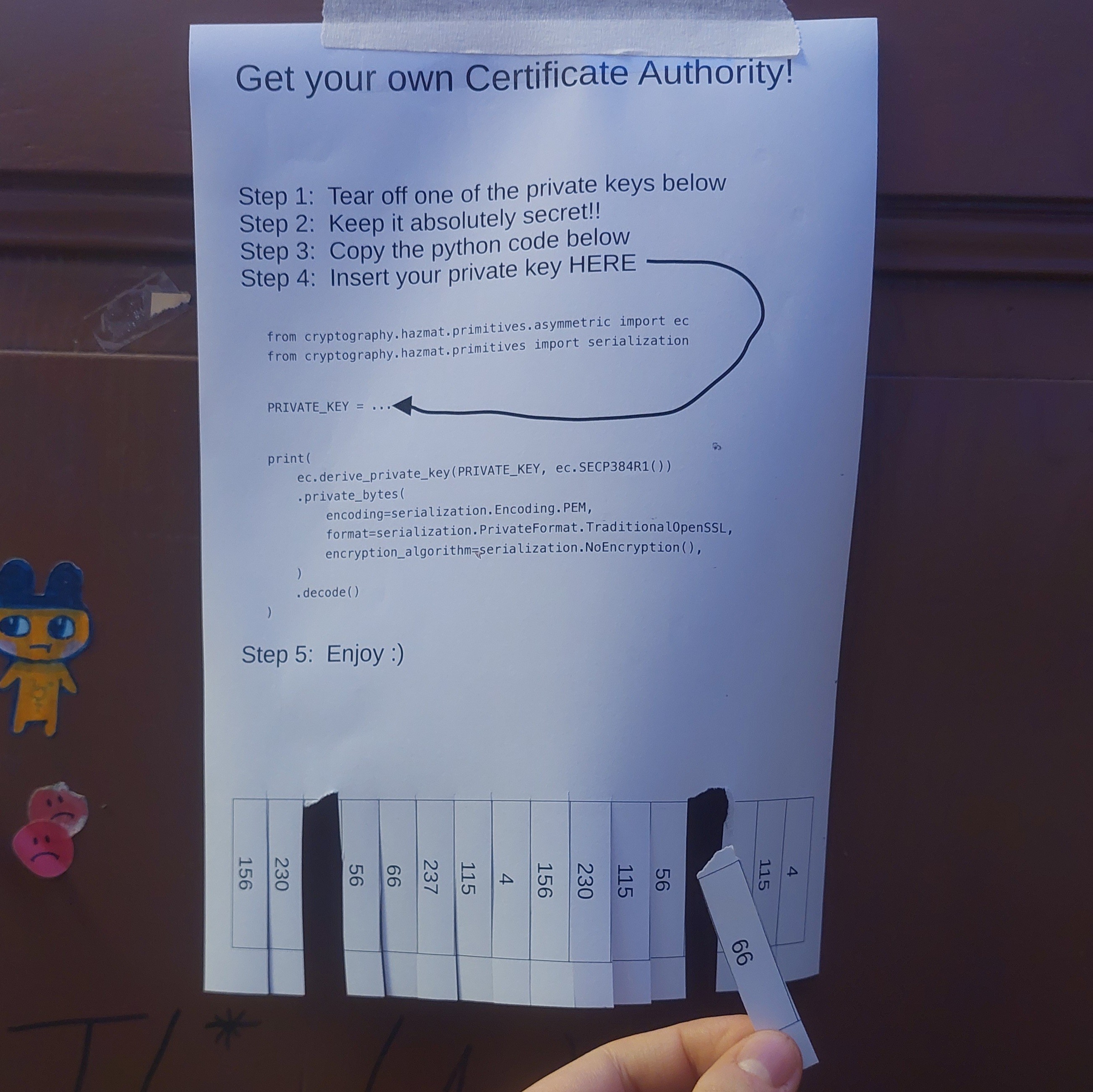
We now provide pre-computed secure private keys for certificate authorities in need
I traced this this down to a missing -f flag in openRC's implementation, so after some testing, I fixed this.
Thanks to @navi and LeePen for helping with this!

"Can we design for where we could go, rather than adopt an LLMs to make
it supposedly easier to stay where we are? " - Enrico Zini ( @spanezz )
Using it for software generation is wrong on multiple levels. And it does not help furthering Debian goals of free software at all, the opposite is the case: lock-in for proprietary one.
Using it for software generation is wrong on multiple levels. And it does not help furthering Debian goals of free software at all, the opposite is the case: lock-in for proprietary one.

The new #LLM debate in #Debian has made clear to me that we loose the incentives to solve
a) our technical problems using deterministic and less energy-wasting classical methods (Lintian)
b) our social problems by talking to each other (teaching upstreams about SPDX and other machine-readable methods to declare copyright)
Of course this is only one facet to the LLM problem (there are larger issues) but I joined Debian because I want to do the right thing and not "paper over" real problems.



Mit der Bitte um Beachtung: https://umsteigen.info

idk man, i just think we can't let the sloppers win and take all our spaces and all our hobbies and all our joy from us. we gotta fight back, and if we have to make our own new communities that ban slop to replace old ones that didn't have the backbone to do it, then that's what we gotta do
and i'm not saying it'll be easy. i'm saying that unless we wanna just lay down and give up and die that's our only choice





I #Selfhost my email server (that handles my 20+ domains) since almost 20 years now, currently on a cheap virtual machine running Linux, with 1 CPU core, 2G of RAM, 40G hard drive and unlimited network traffic which costs me less than €5/month.
Many people keep on telling me that running your own email server is more or less impossible. I simply don't listen to them.
I explained my setup in a blog series starting at https://jan.wildeboer.net/2022/08/Email-0-The-Journey-2022/

If like me you are angry at the "AI industry", and can afford it, channel some of your anger into supporting creatives.
I know Patreon (and similar) are not perfect, but it's a lot better than nothing.
If you like and use "big AI", then consider throwing a few dollars in the direction of the people that actually make "training data".
Outside of a privileged few (like me!) people creating the open web have had a precarious existence before the "LLM revolution", and it has only gotten worse.
And yes, your local model was also trained on other people's work.

Did anybody notice the Anthropic article the other day demonstrating instruction-level formal verification of FOSS libraries?
I notice that one of the target libs was `simdjson`. Their compilation target was riscv64gc, an instruction set that does not even support SIMD. So, their 'formal verification' skips basically all of the useful functionality provided by the library.
Yes, that's right, they spent (presumably?) millions of dollars of tokens proving the memory safety of a fallback JSON parser that was already written in Rust (correction: C++).
I'm so tired of this stupid dead cat marketting that falls apart under the most basic of scrutiny. A $1.5 Tn company, apparently, and they can't even be bothered to check that their publications make sense at the most basic level.

There is no such thing as "ethically using AI". AI is trained on stolen data. AI is destroying the environment and communities. AI is making us stupid. Use AI if you want, just don't pretend you're doing it in ethical way.