


pleroma.debian.social

pleroma.debian.social

Jonathan Dowland | @jmtd@pleroma.debian.social

Principal Software Engineer on #OpenJDK #IBM. #Debian developer. PhD in Computing Science. Amateur historian (Computing Science and H/W, esp. Commodore Amiga). Guerilla archivist.

@rivets I thought I did too ;) At some point I want to look at making blog posts first-class Fediverse objects

https://jmtd.net/log/lanzarote A stream-of-conciousness blog post to get back into the habit, discussing our holiday to Lanzarote, Autistic Burnout, the UK special needs education system, Pandoc parsers, the AI control problem and the issue of copyright and LLMs.

Hmm my blog-to-fedi thing isn’t working it seems

@textfiles thank you for your service 🫡

POLL: Fedi people, do you have a website or blog or personal wiki or some other kind of online Thing That You Control Yourself that other people can find you on that isn't paid for / maintained by someone else, meaning YOUR THING is at a web address like you.whatever, not at you.someonelse.whatever or someoneelse.whatever/you, I mean are you paying the tenner a year or however much for a whole-ass domain name all for yourself (or for you and a small group of IRL friends), and if not do you want to be, THE POLL, and here is the guidance and elaboration on options:

1) No and I don't want my own site, Fedi and/or other social media scratches that itch for me just fine and I'm content with this arrangement

2) No, but I have a Vague Yearning or a Curious Itch and I wonder sometimes what it would be like, but so far it's just feelings and not plans, I haven't taken any concrete steps towards making My Own Website a real thing that exists, but I'm comfortable saying that I would probably *like* it to exist some day when I'm ready

3) No, but more of a Not Yet than a no; maybe I've bought a domain name and not put anything on it yet, or I haven't yet bought a domain name but I'm researching my options (whether I do it in a lazy few minutes here and there or in focused making-notes sort of study, both count for the purposes of this question), I've spent some time thinking about this With Intent, and I feel less "*wouldn't* this be nice" and more "*won't* this be nice" about this endeavour

4) Yes I own at least one domain name, come on Dan this is Fedi, and at least one of my domains even have websites or services associated with them

BOOST THIS TOOT to get an INCREDIBLY INACCURATE IMPRESSION of how many people have and/or want websites and a more accurate picture of how many people On Fedi have and/or want websites

My primary reason for working on a moinmoin reader for pandoc has gone away (change of strategy for migrating Debian’s wiki) but I’ve kept working on it anyway.

@Anarcat @b0rk I could get behind a split like that, if our default man viewing tools could handle cross references and such better. Obviously non-default ones do, but the default is important imho because it’s what beginners will experience

@textfiles hi, random Q, I think you have a one-page site with a fanfare ending “internet!!!!” But I can’t remember what it is. Can you tell me please?

@pndc yes. To be clear that was an extrapolation of my argument to not fix known issues; I don’t feel it should be done!

@pndc I wouldn’t describe a vulnerability as a back door unless it was not well known or deliberately obscured. I do feel the plain text nature of telnetd is a fault, yes, but I appreciate others may not. There are other decision decisions I also feel are faults (e.g. accepting the client’s ENV). Also, it’s de-facto unmaintained.

Reasons `less` is a reasonable default man pager: scrolling up and down, and quitting, are reasonably intuitive and discoverable for beginners. Beginners benefit the most from being able to read man pages.

I’d love it if the default could also handle jumping to (and back from) a cross-referenced manual. (Neo)vim does this, but IMHO would be a bad default for other reasons.

Does fixing security faults in telnetd simply encourage people to use it? IOW, would deliberately _not_ fixing them be a better strategy? I suppose that argument could extend to: would it be good to _introduce_ security bugs to telnet, overtly?

@werdahias I’ll have to take a look. At the moment I use nvim which is better than a simple pager but I feel needs more

Julia’s excellent vlog about man pages (https://social.jvns.ca/@b0rk/116093529820975727) reminded me I was thinking about Debian’s policy of “every tool should have a man page”, and how often that isn’t true.

I’d like to see the default man viewer have some more quality of life features, especially for newer folks

a few thoughts about clarifying man pages https://jvns.ca/blog/2026/02/18/man-pages/


PSA: If you block the `claude` user on GitHub, you'll get a warning every time you view a repo with that user in its commit history.

Now, the moment you look at a repo, you can immediately adjust your expectations.

You may do so here: https://github.com/settings/blocked_users
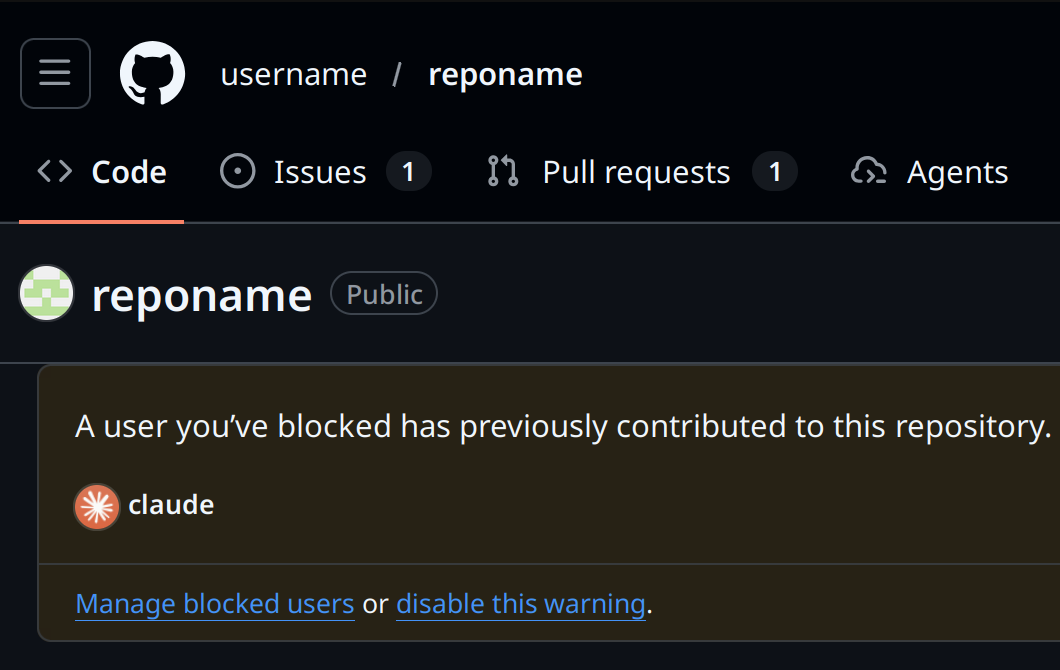
A github screenshot showing a repo with the message "a user you've blocked has previous contributed to this repository"

@vaurora eating lunch at a resort hotel with my youngest daughter. About half way through a week vacation. Unclear if it was a good idea taking my eldest, who is in autistic burnout. Some good moments, some bad.

Memory Safety for Skeptics (Communications of the ACM)

https://cacm.acm.org/practice/memory-safety-for-skeptics/

If you’re tired of hearing about memory safety, this article is for you.

I really like HTF which uses a pre-processor to discover your test functions (you must name them e.g. `test_foo`) but it is an approach with serious limitations. Tasty (the framework Pandoc uses) has a companion library `tasty-th` (or similar) which does discovery using template Haskell, which seems like a good approach. I might try it during dev; I’m not sure pandoc would accept another dependency for a new reader.

It’s also strange to me that the pandoc testing strategy is entirely around the top-level function you export from a reader. No unit tests of any utility functions, which is an approach I prefer. I also prefer in-module tests (so you can test stuff you don’t export). My tastes may not align with the zeitgeist.

»